What comes to mind when you hear self-defense? Stun guns or pepper spray? Bruce Lee, Jean-Claude Van Damme, and Chuck Norris disarming and taking down “bad guys”?
Despite being highly cinematic and unrealistic, this is what comes to mind for many people.
Dictionary.com defines self-defense as “the act of defending one’s person when physically attacked, as by countering blows or overcoming an assailant: the art of self-defense.”
While I cannot disagree with that definition, it does not show the whole picture. Although counterattacking—or even preemptively striking—can be considered self-defense, physical action is only one aspect of what self-defense truly involves.
The stages of an attack
Military and law-enforcement analysts have broken attacks into six stages. I have slightly modified the cycle to fit the context of personal self-defense:
- Target selection
- Observation of the target
- Attack planning and training
- Execution
- Escape
- Exploitation
I organize self-defense around three broader phases:
- Pre-attack
- Attack
- Post-attack
The six stages of an attack fit within these three phases.
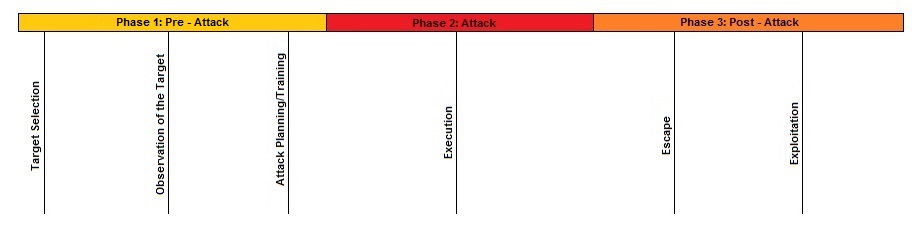
The three phases of an attack.
A broader definition of self-defense
With these phases in mind, we can define self-defense more completely:
Self-defense is the defense of oneself or others through the actions leading up to, during, and after an attack.
Most self-defense classes and martial-arts studios focus primarily on the attack phase. It is also important to understand social and asocial violence and learn how to avoid unnecessary danger.
That does not mean the physical attack phase is unimportant. It is absolutely important to train for. But why focus on only one aspect of protecting yourself and the people you care about?
Learning how and where attacks develop—and how to recognize pre-incident indicators—can greatly improve your safety. Learning how to deal with the emotional, criminal, and civil aftermath of an attack is also an essential part of self-defense.
Before and after the physical encounter
I teach all three phases, but I emphasize the importance of the pre-attack and post-attack phases.
Why not avoid the incident altogether when that is possible?
If I need to defend myself or someone else, it is also critical to understand how to handle everything that comes afterward.
Physical skill matters. So do awareness, avoidance, judgment, preparation, and recovery. Together, they form a more complete approach to self-defense.
References
- “Self-defense.” Dictionary.com Unabridged. Accessed December 7, 2013.
- Stratfor Global Intelligence. Stratfor on the Terrorist Attack Cycle. October 3, 2012.
- Gavin de Becker. The Gift of Fear. New York: Dell Publishing, 1997, p. 116.